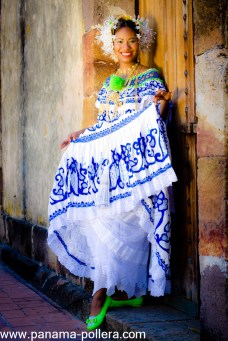
| The Pollera is the most beautiful and admired national costume of the Americas. There are many tales related about its origin, but the popular opinion is that it was adapted from a gypsy dress worn in Spain at the time of the conquest of Peru and brought to Panama by the servants of the colonial families. It normally consists of a blouse or shirt and a two-tiered full skirt.The lavish satins and brocades that made up the dress of society at that time were not suited to the tropical climate and the servants’ garb was appropriated by the mistress and enhanced with lace and embroidery. It was not worn outside of the home but gradually the ladies added more lace and ribbons, ornaments for the hair (tembleques) and jewelry for the neck and eventually it made its way into the public eye.
The experts agree that the ground cloth must be white and the 12 yards of material required can be fine linen, cambric or voile. The motifs may be formed by birds, flowers, fruit, vines, garlands or native designs. The height of elegance is achieved when these designs are executed in “talco en sombra” which is hand-sewn appliqué; however, they can be also created in cross stitch or embroidery. The cost of the gala costumes runs into hundreds and sometimes, thousands of dollars, depending on the hand work involved. The basic pieces of the pollera are the gown or upper part, the skirt or lower part and the petticoat or underskirt. The gown or blouse consists of two ruffles, appliquéd or embroidered in favored color and design edged with valencienne lace and gracefully draped from handmade thread lace insertion at the neckline (this blouse is worn off the shoulder.) Wool is woven in and out of the insertions and two big pom-poms are centered at the chest and back. The wool must be the same color as the shoes, which are heel-less and made from velvet or satin. The skirt is two wide pieces ornamented with the chosen motif and joined together with insertion and bordered with insertion and lace. It is very fully gathered on a waist band. Four wide ribbons hang from the waist, two in the center front and two in the back–they are called “gallardetes”, meaning “graceful streamers”. The petticoat is often as elaborate as the skirt but is always pure white and the trimming is hand-made thread lace. The ornaments, “tembleques“, for the hair are exquisite. A large tortoise shell comb embellished with pearls and gold is worn on top of the head and resembles a crown. This is the key piece and the gold hairpins and tembleques, which are quivering pins and worn in pairs, are placed on the head to give the appearance of a radiant halo. Two small discs tied to the hair at the temples with black silk thread and large gold filigree earrings with pearls or corals complete the head dress. The jewelry worn with the pollera in the olden days was indicative of one’s wealth and sometimes as many as a dozen chains were worn, all of pure gold and precious gems. A large gold and pearl button or rosetta is worn over the wool pom-pom and a purse suspended from the waistline and fastened with two gold brooches is the finishing touch. |
 mymomisachef.com